
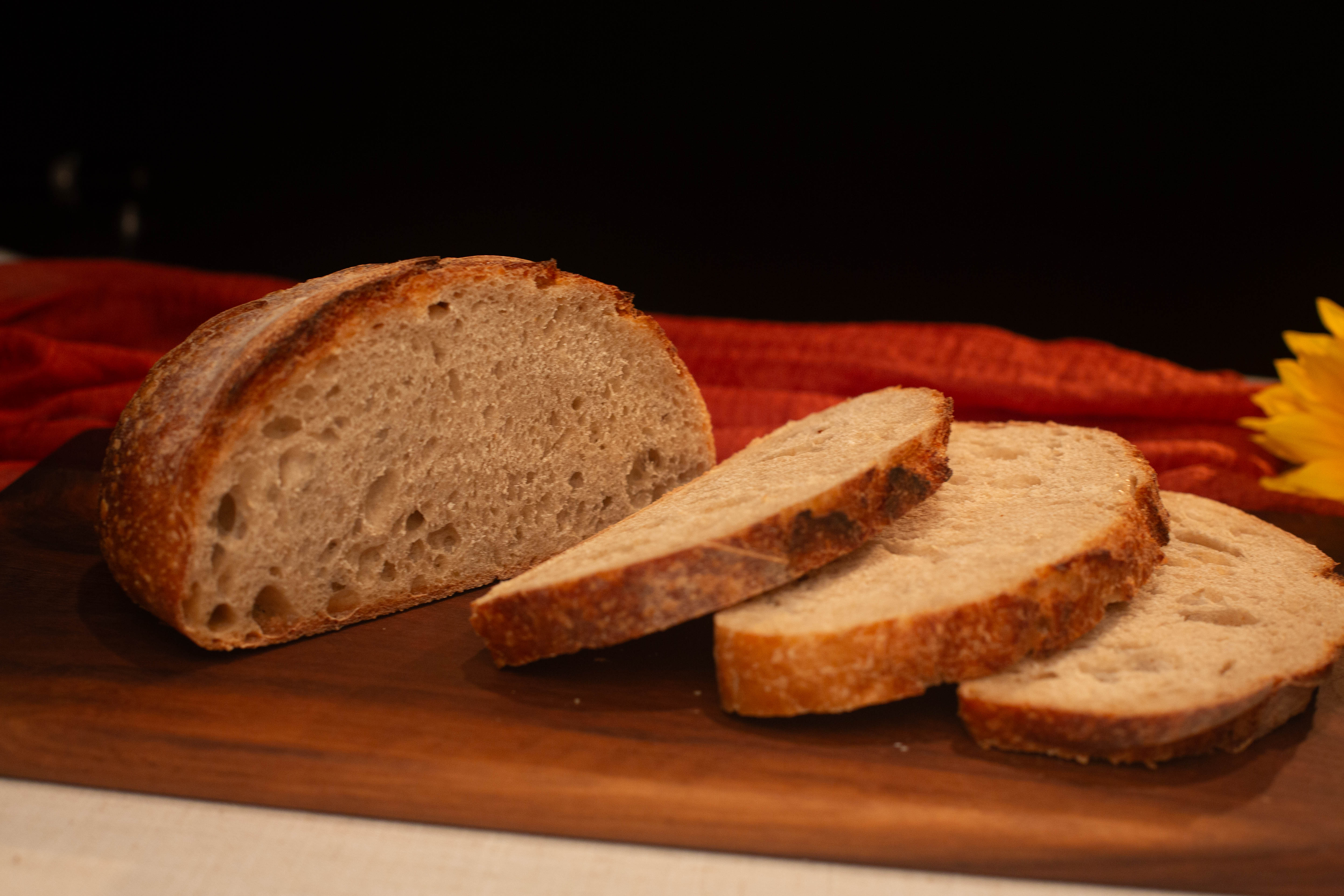
I'm often asked why real sourdough feels better on the stomach. I smile every time, because I love this story, and because it's a beautiful reminder that when we follow nature and tradition, our bodies usually say thank you.
Three ingredients, no shortcuts
True sourdough starts with three things: flour, water, and salt. No commercial yeast. No shortcuts.
The yeast that raises a sourdough loaf comes from the air, the baker's hands, and the flour itself. When we mix flour and water, a little world of wild yeast and friendly bacteria wakes up and begins to ferment. They become partners inside the bowl:
- The yeast eats the natural sugars in the flour and creates tiny bubbles that lift the dough.
- Lactic acid bacteria eat those same sugars and create the gentle tang we love.
- Acetic acid develops the smooth, yogurt-like note that makes real sourdough so satisfying.
That slow, natural fermentation is what builds the flavor you can't imitate with commercial yeast.
The trouble with fast bread
Commercial yeast, on the other hand, is a single strain designed to make bread rise fast, sometimes in as little as 45 minutes. Speed might be convenient, but it skips an important step: fermentation. And that's where the trouble begins.
Humans digest quickly. We aren't built like cows, with multiple stomachs for fermenting grasses. When bread hasn't been fermented ahead of time, like most store-bought and fast-rise breads, your body has to do that work itself. By the time that bread reaches the lower digestive system, it finally begins to ferment right inside you.
That's where bloating, gas, and discomfort come from.
What a full day of fermentation changes
True sourdough is usually fermented for 24 hours, and sometimes up to 48. That long rest changes everything.
Each wheat kernel is protected by phytic acid. Its job is to hold the vitamins and minerals tight until the seed can germinate. When you mix flour and water and give it time, the dough begins to mimic germination. An enzyme called phytase wakes up, breaks down the phytic acid, and releases all those locked-up nutrients. Suddenly the bread becomes more nourishing and more digestible.
During this long fermentation, the microbes are already doing the heavy lifting:
- Gluten begins to unwind.
- Starches become simpler.
- Nutrients become available.
- The bread becomes gentler on your stomach.
Bread your body recognizes
By the time you sit down with your slice, the bread has been partially digested for you. Your body recognizes it. Your belly relaxes. And you get not only better flavor, but better nutrition.
This is why we honor the slow work. Why we give our dough the full day (or two) it deserves. And why so many people who "can't eat bread" discover they do just fine with a true sourdough loaf.
It's nature doing what it's always done, one quiet fermentation at a time.